Land and Blood: Samoan Identity and Climate Change
For a territory with under 200 km2 of total dry land mass, land in American Samoa is at the center of culture and history. Unlike in the mainland United States, land is not an investment to be bought and sold freely. Rather, it is governed by a traditional tenure system, binding families and the traditions they hold to particular plots for centuries.
Nearly all land in the territory is held communally, and is occupied and held in accordance with family lines and village titles. A palagi (off-islander) arriving in Tutuila hoping to purchase a beautiful swath of the island’s beachfront property will be out of luck; by law, land in the territory cannot be conveyed to any person who is less than half Samoan by blood.
Perhaps the most visible manifestation of the connection between land and family is the traditional Samoan practice of burying ancestors on family land. Most homes in the territory are fronted by several elaborate graves—deceased relatives of the family that currently occupies the house.
But this connection also goes beyond what is immediately visible. Okenaisa Fauolo, the Director of the Samoan Studies Institute at American Samoa Community College, notes that understanding Samoans’ attachment to land requires a short lesson in the Samoan language.
“You know, the Samoan word for ‘earth’ is ele’ele,” Okenaisa says, “and ele’ele in Samoan—it’s another word we use for blood.”
The lineage of family land in American Samoa is fundamentally inseparable from what it means to be Samoan. Even names on the island are often tied to place.
“We make sure we name our children after these land names because then it carries,” Okenaisa explains. “You’ll be surprised that once you hear someone mention their name, you knew immediately. When they mention their name is Fuifatu, you know exactly where that person is from.”

The school building in the village of Poloa, on the western side of Tutuila, was destroyed by the 2009 tsunami. Most of Poloa's residents have now relocated to higher ground.
This strong connection between land, family, and tradition has also come under strain in modern times. Coastal land in American Samoa is not only at risk from increased erosion and rising seas, but shorelines also face long-present hazards such as tsunamis and storm surges. And with these risks have come the beginning stages of relocation—sometimes voluntary, and sometimes under pressure from the U.S. federal government.
It is impossible to talk about climate change in American Samoa without addressing a recent tragedy. In the early morning of September 29, 2009, a magnitude-8.0 earthquake struck about 120 miles off Tutuila’s coast. Within minutes, the resulting tsunami had come to shore, devastating villages and killing 32 people in the territory. The tsunami weighs heavy on the collective consciousness of American Samoa. Though not caused by climate change, it was a wakeup call to many that merely living on the water’s edge could put their homes and their lives at risk.

Graves dot the coastline in the village of Vaitogi.
Outside of Okenaisa’s office, Faleosalafai Tipa—Fale, for short—tells us that memories of the tsunami are the first thing that come to mind when he thinks about the island’s vulnerability to climate change. A researcher and former student at the Samoan Studies Institute, Fale is a High Chief Maseuli (Si’ufaga) and a Talking Chief Mago (Sapapalii), both of which were bestowed by his family on the island of Sava’ii in Independent Samoa. He is an eloquent and passionate orator, particularly when talking about the tsunami, which devastated his village.
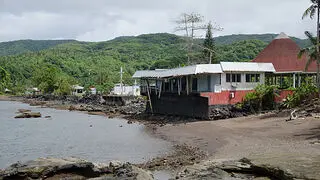
“Our house was on the Pala Lagoon,” Fale tells us, referring to an area in the island’s hardest-hit village of Leone (shown below). “We lived on the ocean shore. In fact, my ancestors— they covered the ground of where my house is now.”
Stay connected with us via email. Sign up today.
In the aftermath of the tsunami, FEMA mobilized over $100 million in disaster relief and preparedness for the territory. But the federal aid also underlined the uneasy fit between the preservation of Samoan identity and autonomy with the growth of American identity and federal governance.
“You can’t just come in and dictate,” Okenaisa says of the FEMA assistance. “For example, FEMA comes in and says to the people of Leone, ‘No one can build here anymore because you’re too close to the ocean.’ Now thank you, [you’re] very kind, we know that. But the answer is no. People have gone right back and started building.”
As American Samoans begin to think about what the impacts of climate change mean for them, the aftermath of the tsunami hangs in the background. Though some villages and families did move further inland after the tsunami, for many in the territory like Okenaisa, land and blood truly are the same—neither can be left behind.

A badly damaged fale and a FEMA tent in the center of Leone.
For American Samoans, the choice isn’t just to move to higher ground or to be flooded out of their homes. Samoans have lived alongside an unpredictable ocean for centuries, adapting constantly to environmental change. This was the point stressed by Sandra Lutu, a deputy director at the American Samoa Chamber of Commerce, who maligns the loss of much of the indigenous knowledge that has long been essential in allowing Samoans to adapt to their environment.
Sandra describes a shift at the turn of the century where American Samoa “became introduced to westernized culture and facilities and processes and just the ingenuity of the western culture,” but at the expense of indigenous knowledge and practices. One of those practices was the use of fales—open-sided thatched roof huts—as homes. While fales still abound in American Samoa, they have been relegated to traditional functions.
“The reality of [climate change] is a lot more visible because we don’t live in traditional-style homes,” Sandra says, “We live in homes that cost us a lot of money. So now that it’s damaging our sea walls and encroaching the footprint of our house structures, now we’re like, ‘Whoa—what’s going on?’”

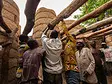
Pua Tuaua (left) and Pai Aukuso-Reopoamo (right), rangers with the National Park of American Samoa, explain the role of the National Park in teaching American Samoans about the long history of the Samoan people.
For Sandra, adapting to climate change means finding a better fit between modern technology and the knowledge that allowed communities to thrive in the Samoan archipelago for thousands of years.
“I think everybody in the Pacific is in the process of adapting,” she tells us. “Adaptation is good. But adaptation doesn’t mean to completely ignore one way and do another. Adaptation means to combine and adopt areas and things and processes that will strengthen whatever it is that you need strengthened.”
In some senses, this is a hopeful takeaway from what climate change might mean for American Samoa. If an artificial insulation from the environment led to a loss of culture and identity, the need to adapt today presents an opportunity to revitalize the cultural heritage that was lost.
“We’re at a standstill now,” Sandra explains, “and we’re looking back and realizing that [they] needed to coexist—our indigenous knowledge and practices—using the scientific data to either justify or support our practices, or to progress into a more adaptive state that doesn’t deteriorate our cultural practices but only strengthens them.”
This was Okenaisa’s point, too. “If my people have been around for 3,000 years—more than 3,000 years—we’re doing something right to be around for this long,” she says. “And we would like to be around for another 3,000.”
Save Historic Places That Tell Our Full American Story
When you join the National Trust, you help save historic and culturally significant places nationwide.
.webp)